Overview
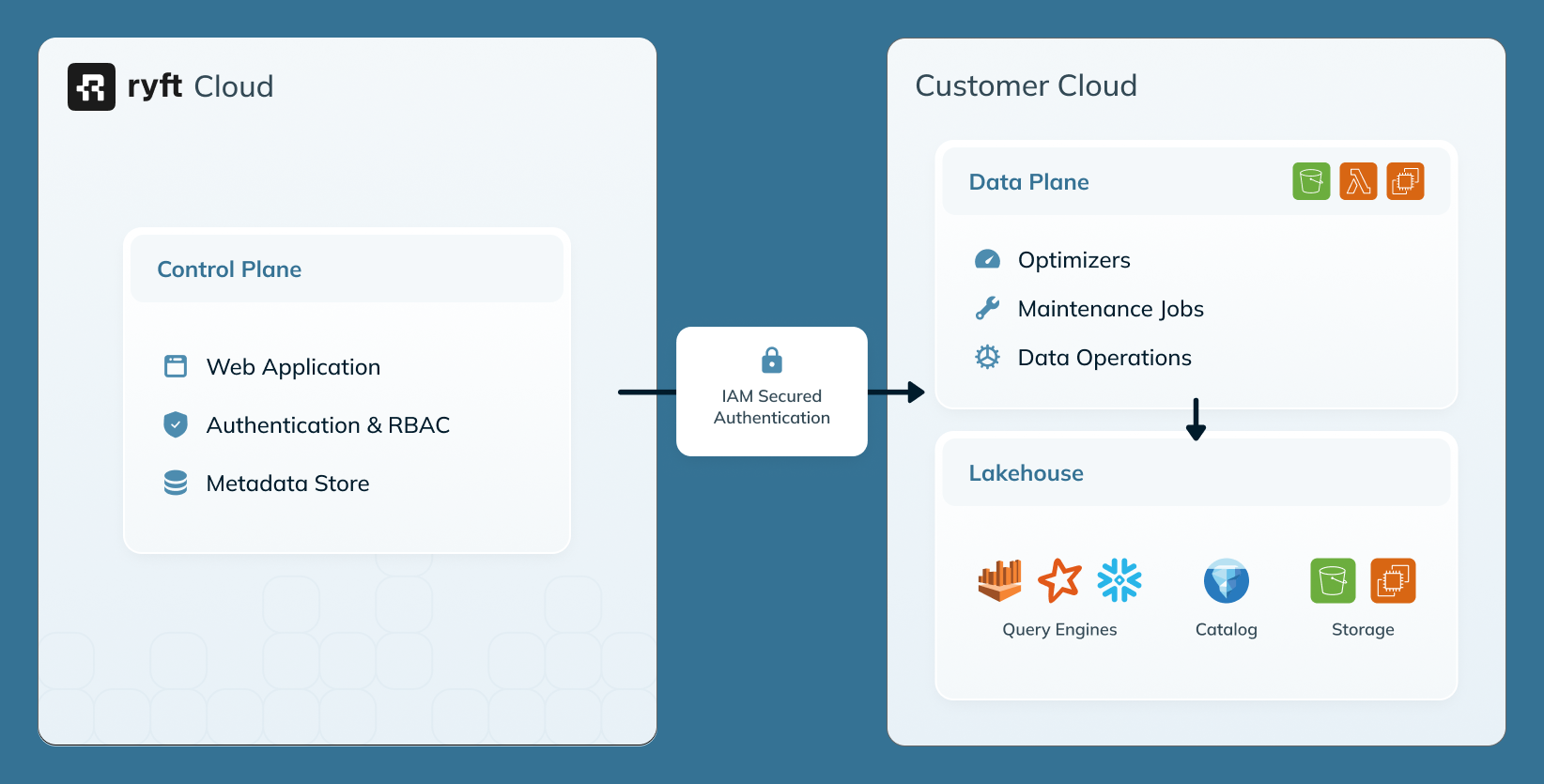
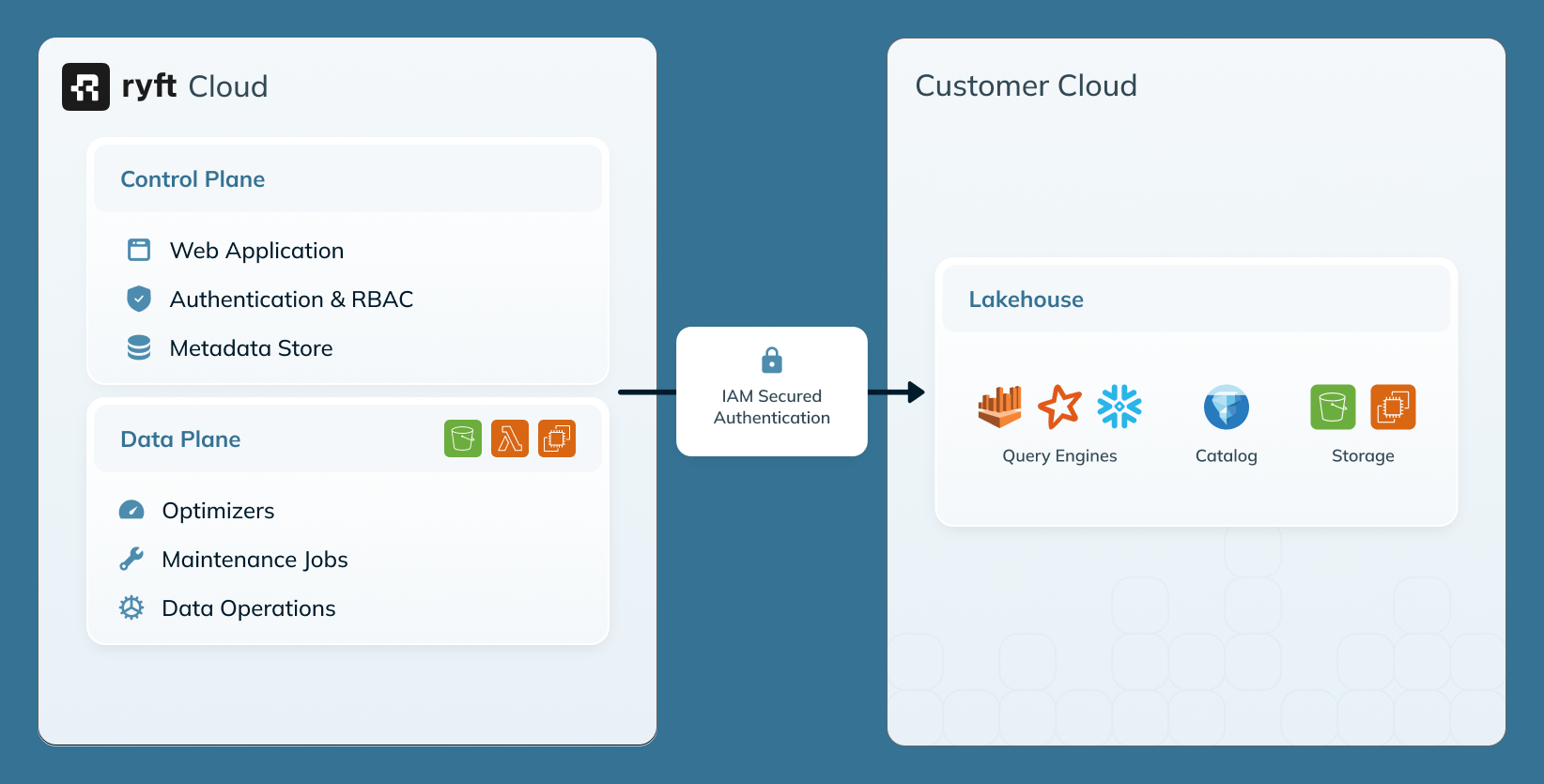
Ryft’s architecture consists of two separate planes:- Control Plane - hosts the UI, authentication, and the metadata store
- Data Plane - executes optimizations and compute workloads on your Iceberg lakehouse
Control Plane
The control plane is responsible for management and metadata operations, such as:- UI and API services
- Metadata store
- Authentication and access control
- Job orchestration and monitoring
Data Plane
The data plane is responsible for data operations and compute-intensive workloads, such as:- Data compaction
- File layout optimization
- Table maintenance
Deployment Models
Managed
In this deployment model, both the control and data planes are hosted and operated by Ryft. This is the fastest way to get started with lakehouse optimization. Although fully managed, the planes remain logically and physically isolated:- The control plane runs in a multi-tenant environment managed by Ryft.
- The data plane runs in a dedicated cloud account provisioned and managed by Ryft.
- Both metadata and data operations are performed in Ryft cloud.
- The data plane runs in its own dedicated and isolated VPC.
- Ryft manages all infrastructure, including provisioning, upgrades, monitoring, and scaling.
BYOC (Bring Your Own Cloud)
In the BYOC model, the control plane is hosted by Ryft, while the data plane is deployed in your cloud environment. You provision a dedicated cloud account, and Ryft manages and operates the data plane infrastructure within it. Highlights:- Your data never leaves your environment - all data operations are executed within your cloud environment.
- You retain full control over access policies, networking, and resource usage.
- Data operations are triggered and monitored via the Ryft-managed control plane, but are executed within your cloud account.