

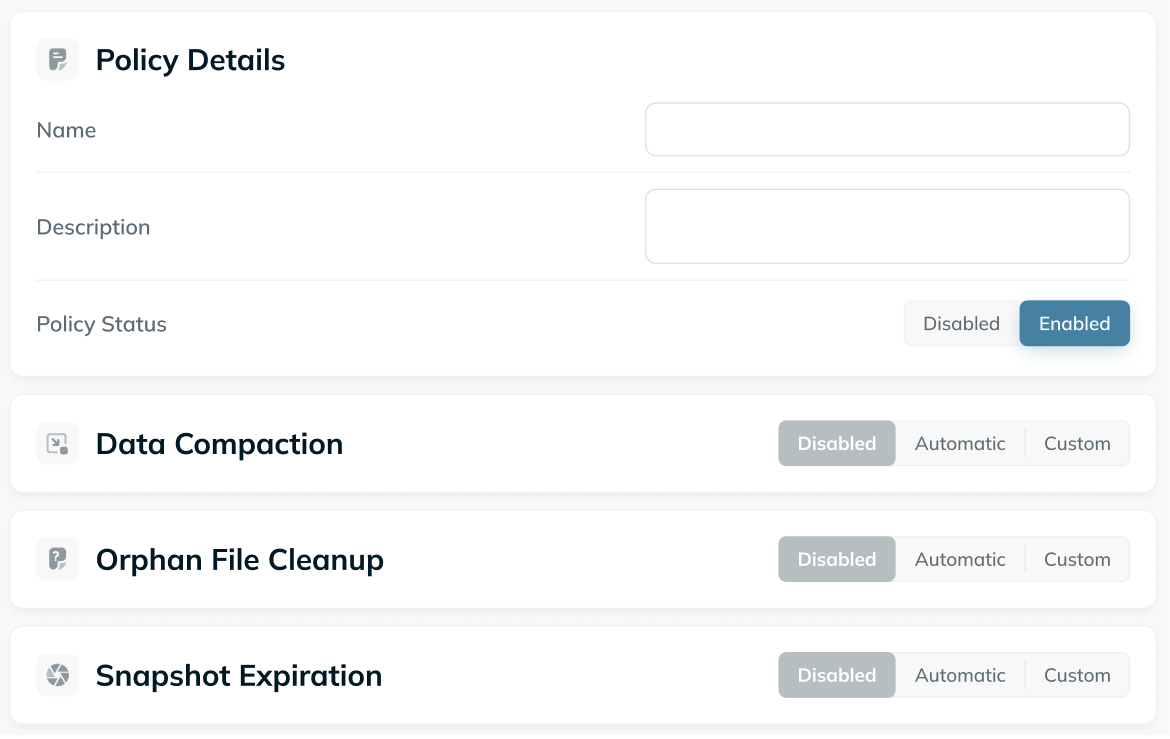
- Policy Details - name, description, and status
- Policy Scope - defines which tables the policy applies to
- Optimizer Settings - individual settings for compaction, orphan file cleanup, snapshot expiration, etc.
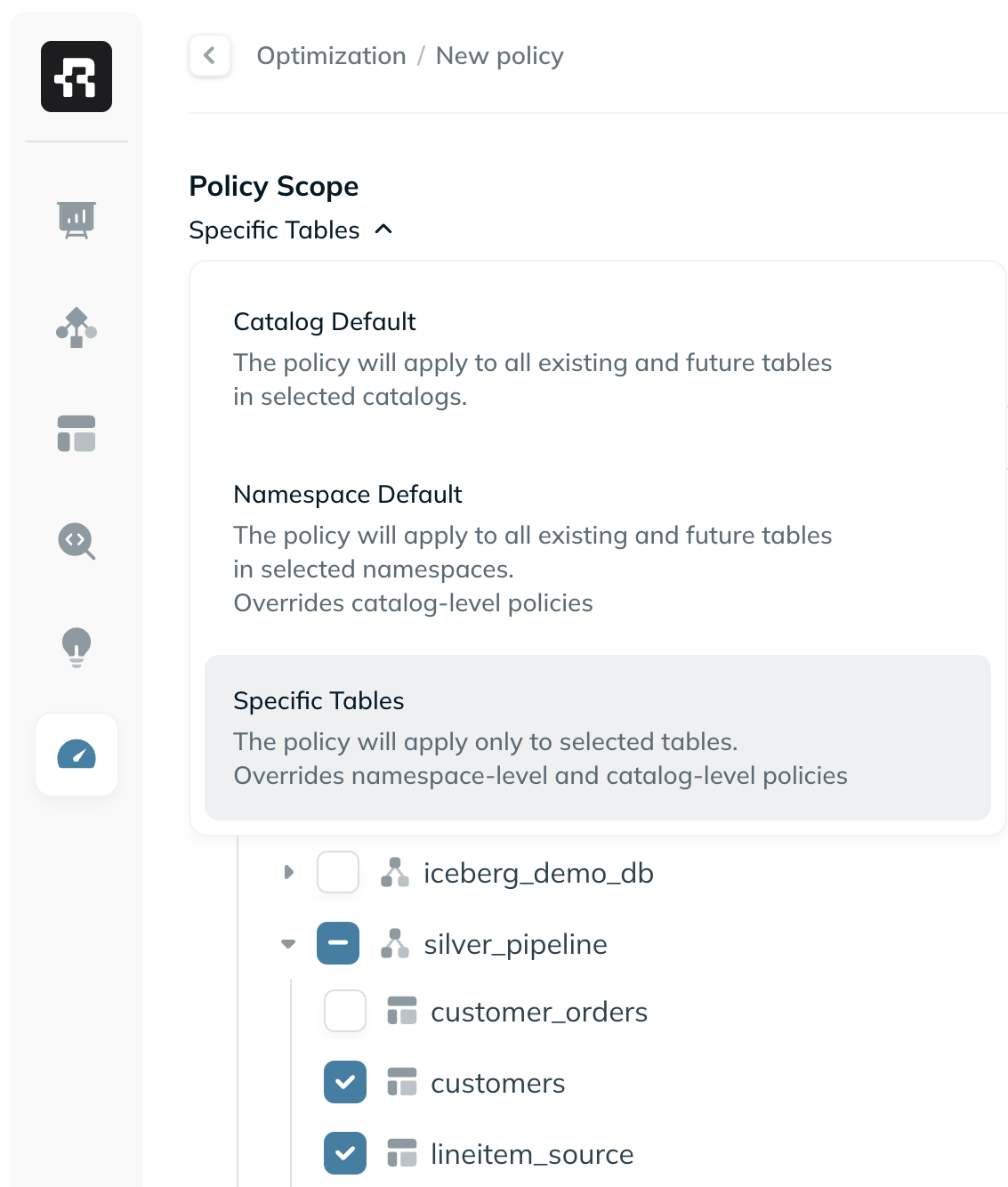
Policy Scope
The policy scope controls which tables a policy targets. You can choose between:Catalog Default
A single policy that applies to all current and future tables in the catalog - unless a namespace-level or table-level policy explicitly overrides it.- Only one Catalog Default policy can be enabled at any given time.
- It serves as the baseline policy for all tables in the catalog.
Namespace Default
A policy that applies to all current and future tables in the selected namespaces - unless a table-level policy explicitly override it.- It serves as the baseline policy for all tables in the selected namespaces.
- These policies always take precedence over the catalog-level policies.
Specific Tables
You can explicitly define policies for specific tables. These override the default policy for the selected tables.- Each table can only have one “Specific Tables” policy.
- These policies always take precedence over the catalog-level and namespace-level policies.
- Policy #1 -
Default Policy: automatic settings for all tables. - Policy #2 -
Bronze Policy: settings for the bronze namespace, that requires more aggressive snapshot retention settings. - Policy #3 -
Policy for enriched_events: applies manual data compaction and custom snapshot retention for that specific table. - Result:
enriched_eventsuses the specific policy, bronze tables use the bronze policy, and all other tables use the default policy.
Optimizer Settings
Each policy includes configuration for every optimizer available in Ryft. For each optimizer, you can choose one of three modes:- Disabled – the optimizer is turned off for this policy
- Automatic – optimizer behavior is managed by Ryft, including automatic self-tuning and intelligent settings based on table behavior
- Custom – you configure optimizer behavior manually, allowing fine-grained control of the optimization procedure (e.g., strategy, schedule)
Ryft’s Optimization Policies balance simplicity and control - enabling automation where you want it, and precision where you need it.